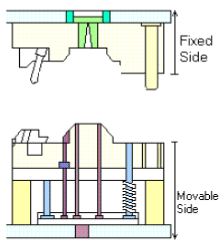
Two plate mold has one parting line which is consist of fixed and flexible plates. Fixed plate attach to stationary platen on injection machine where resin is ejected. Flexible plate attach to moving platen on injection machine where has clamping system.
1. Advantage of two plate mold.
+ Simple structure, easy for making,
+ Mold fee is cheaply. Cost of product can be reduced.
+ Fast cycle,
2. Disadvantage of two plate mold.
+ Need equipment for gate cutting.
+ Sample has runner and gate, it is not suitable for automation and energy-saving. Runner and gate need destroy after injection so it squander resin.
3. Two plate mold construction.

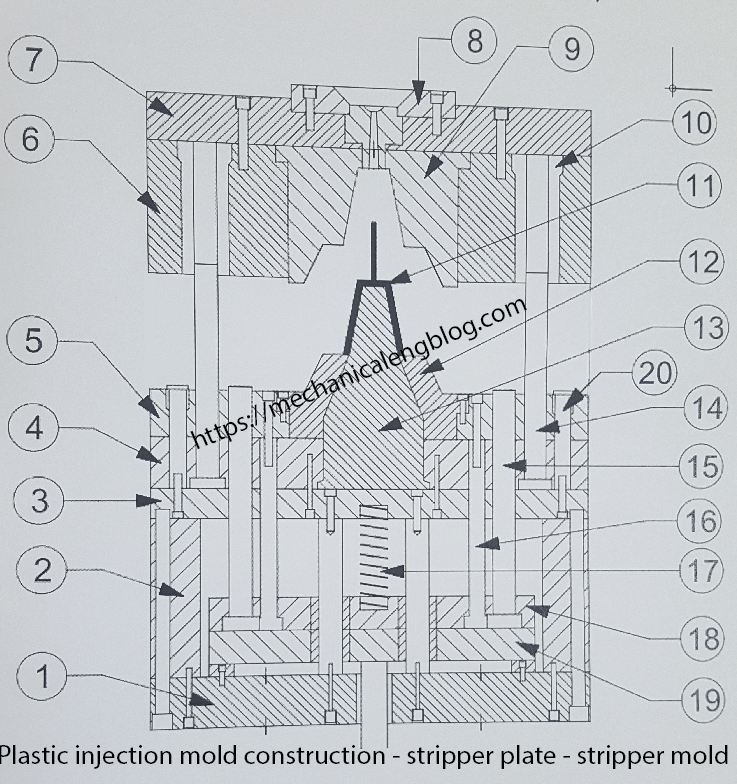
+ Locate Ring: It is same guide when we assemble mold into injection machine. Balance Nozzle of injection machine and sprue bush.
+ Sprue Bush.It is the connecting member between nozzle and mold. A channel to transfer molten plastics ejected from the nozzle.
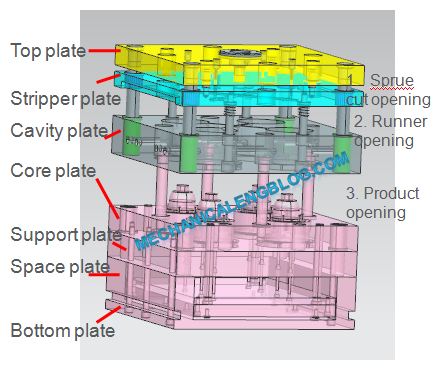
+ Top Clamping Plate: Holds the fixed side of the mold to attached at the fixed plate of the injection machine. This plate will attach locate ring, bolt, and sprue bush.
+ Bottom clamping plate: Hold the movable side of the mold such as: spacer block, support plate, cavity plate and ejector system to the movable platen of the injection machine.
+ Guide pin & guide bush.It is used as a guide to align a cavity core.Usually four pins are installed.
+ Cavity plate: Use for make appearance of product, it can attach runner system, guide pin, cooling system,…
+ Core plate: Use for make structure of products, I can attach ejector system, cooling system,…
+ Slide core: Use it when we solve undercut of products.
+ Support pillar. It will increase hardness for core block palate
+ Return pin.A pin used to avoid damage to a mold by colliding with the parting line surface, pushing down an ejector plate to return an ejector pin to the original position when a mold is closed.
+ Sprue lock pin. A pin has undercut. It pull a part in mold opening and remove a sprue from a sprue bush.
+ Ejector plate & stop pin.
Ejector plate: Pushes the ejector pins and return pin, connect with ejector rod.
Stop pin: to keep an ejector plate horizontal or prevent the ejector plate from retreating too far and damaging a core adaptor plate.
+ Ejector pin. Pushes products go out to the mold

Leave a Reply