Many people often wonder about the concept of a stainless steel flexible joint when encountering this type of equipment in their daily lives. To address this curiosity, In this article mechanicalengblog.com will explain what a stainless steel flexible joint is
I. What is a Stainless Steel Flexible Joint?
A stainless steel flexible joint is an accessory used in the piping industry, primarily constructed from stainless steel. It possesses excellent flexibility, allowing for bending and movement. Its main function is to minimize or eliminate undesirable vibrations and shocks that can occur within the pipeline. Moreover, it enables easy and flexible repositioning of the pipes.

In any piping system, one of the major concerns for designers, constructors, and operators is the potential damage caused by vibrations and shocks during operation. Vibrations and shocks can result from installing pipes near engines, machinery, or due to water hammer effects.
video of the vibration on the pipe due to the installation near the engine.
Without proper attention, prolonged exposure to vibrations can lead to pipe failure, including cracking, leaks, or even breakage, resulting in fluid leakage. This poses risks to worker safety and system integrity. Consequently, stainless steel flexible joints, also known as anti-vibration joints or expansion joints, are frequently mentioned as essential components in both small and large-scale piping projects.
II. Applications of Stainless Steel Flexible Joints
To gain a more realistic perspective, let’s explore real-life applications of stainless steel flexible joints. These products find extensive use in various residential and industrial piping systems, including:
Example:
+ Fire Protection Systems : In fire protection systems, a control station and high-pressure water pumps are utilized. Even the highest quality pump systems are susceptible to vibrations during operation. Additionally, the internal pressure of the fluid is often substantial. To address these concerns, stainless steel anti-vibration joints are manufactured and installed to isolate and eliminate vibrations between the piping system and the pump assembly. This ensures the safety of the fire protection system.

+ HVAC Systems: Heating, ventilation, and air conditioning (HVAC) systems require flexible joints to absorb vibrations and shocks caused by the operation of HVAC equipment, such as pumps, chillers, and air handling units. Stainless steel flexible joints help protect the HVAC system and maintain its stability.
+ Water Supply and Drainage Systems: In both residential and industrial settings, stainless steel flexible joints are used in water supply and drainage systems to absorb vibrations and compensate for thermal expansion and contraction. They provide flexibility and prevent damage to the pipes and fittings.
+ Oil Refineries and Industrial Boilers: Stainless steel flexible joints play a crucial role in oil refineries and industrial boiler systems. They absorb vibrations and compensate for thermal expansion within piping systems carrying various fluids. These joints contribute to maintaining system integrity, preventing damage, and averting leaks.
III. The Structure of Stainless Steel Flexible Joints
Mechanicalengblog.com will explain the structure of stainless steel flexible joints. In reality, this type of equipment consists of three main components: the inner tube (bellow), the outer mesh (braid), and various types of fittings.
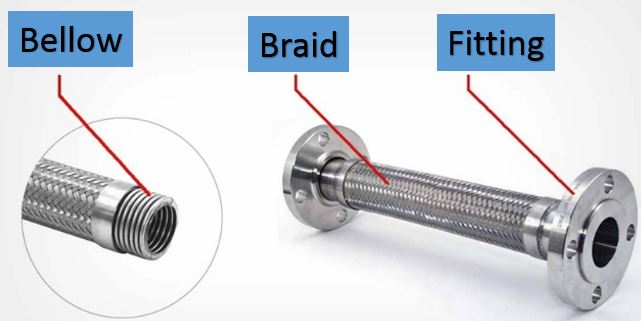
1. Inner Tube (Bellow):
It is the component that directly contacts the fluid flowing through the pipeline. It is made of high-quality stainless steel (such as 304L, 316L, 321L, etc.). The bellows are the most critical part of the flexible joint as they determine its flexibility and durability.
Are you concerned about the corrosion or rusting of the pipes over time due to the impact of the conveyed media (such as acids, nitrogen, hot water, etc.) and oxidation? Now, with the bellows made entirely of stainless steel, these concerns can be eliminated due to stainless steel’s excellent resistance capabilities.
The advantages of using stainless steel pipes are numerous: they are resistant to oxidation, can withstand high temperatures and pressures, and are suitable for even the most aggressive media, such as acids and liquid nitrogen. Additionally, they help reduce annual maintenance and replacement costs. It offer high bending and flexibility capabilities. That is why they are commonly referred to as stainless steel anti-vibration joints, anti-vibration flex connectors, or flexible metal hoses.
However, it should be noted that the cost of stainless steel bellows is higher than conventional piping materials.
2. Outer Braiding (Braid):
The outer braid serves to protect the inner tube and enhances its pressure resistance, often increasing it by several times. It is also made of stainless steel, either 304 or 316, depending on the specific requirements. At E-Flex Vietnam, users have the flexibility to choose the number of braid layers: 0 layers, 1 layer, 2 layers, etc., to suit the installation location.
3. Fittings:
Stainless steel flexible joints have two fitting ends used for direct connection to the piping system. There are several common types of fittings available in the market for stainless steel flexible joints, such as:
Flanged stainless steel flexible joint
Tapered stainless steel flexible joint
Threaded stainless steel flexible joint
Quick-connect stainless steel flexible joint
These fittings allow for easy installation and secure connection to the respective piping system.



Leave a Reply